What are some executive coaching, management education management training topics?
Leaders in the executive training, leadership training room are defined by actions, not titles.
Now more than ever, we need strong leaders. Throughout this time of turmoil in the work environment, we’re seeing an even higher interest in our most popular management training topics in addition to our leading team-building programs, ( turnkeycoachingsolutions.com/strategic-planning-consultants-business-growth-retreat/ ) since organizations realize this is a critical time to buy management development.
Executive training, leadership training is an apparent one and a topic that will just be more crucial in the months to come. Effective virtual management abilities are truly vital now. How do you lead a team you can’t see in person? How do you inspire and engage people around the world from your home workplace? Virtual group leaders need a brand-new set of abilities partnership, interaction, trust-building, ensuring accountability, leveraging technology, and a lot more.
In our progressively detached, remote workplace, it will be the people who recognize the significance of human connection and emotional intelligence that will increase to the top. Organizations want leaders who can connect to the ideas, feelings or experience of others. In today’s work environment where most of our connection happens through screens, emotional intelligence provides the tools to see and translate non-verbal body language.
A lot of recently promoted managers and supervisors are thrust into their management roles entirely unprepared. Moving from ‘bud’ to ’employer’ is a complex transition that requires training and new abilities. Go here: read Getting the promo is simply the beginning. New leaders need upskilling to make a smooth and highly effective transition to their new function.
Take it from us, investing in your new managers will pay off literally, with significant ROI in recruitment and retention. This Management Bootcamp is the ideal jumpstart and investment in your new leaders. Management coaching may be the very best way to get important insights into your strengths and opportunities and to end up being the extremely finest variation of yourself as a leader.
And management coaching pays off literally. According to the International Coaching Federation leaders who took part in coaching saw 50 70% boosts in work efficiency, time management, and group efficiency. The same research study likewise found that 86% of companies who used coaches made back their preliminary investment in the coaching process.
Identifying your own personality style is the foundation of understanding your management style. As soon as you understand the most natural way for you to lead, you can much better communicate, construct trust, and inspire your group towards its goals. It’s the basis of authentic management, where listening and leading are highly compatible, and acknowledging your strengths and weak points drives greater group trust, open interaction, and positioning.
That same clinically proven behavioral assessment and neutral, non-judgmental process for understanding our differences is the basis of Whatever. A sensible person once said, “your comfort zone is a lovely place, but nothing ever grows there.” IBC started using Brown’s “Dare to Lead.
In light of recent events, people are extremely thinking about Brene Brown’s viewpoint of brave management where leaders are asked to step up and there is no space for “bunker mindset.” The world is truly desperate for braver leaders resistant leaders who can adjust to hardship without judgment or avoidance; leaders who can be vulnerable and empathetic; leaders who understand how to select courage over comfort in the most tight spots.
Related Post
Kinds Of Supper Event Invitations Available TodayKinds Of Supper Event Invitations Available Today
If you have been welcomed to a party or occasion, among the first things you will probably want to do is discover what dinner party invitations to send. Naturally, the majority of people never also think about it up until they arrive and also they are stressed and also tired out regarding obtaining all the invitations arranged and also ready to go. However what if you did not obtain an invite? In this post, we will cover dinner party rules and send invites the right way.
It is simple to take too lightly the amount of job involved in sending out supper event invites. There are a lot of different things that require to be thought about and also sorted out before any individual can ever be invited to an event. The first thing that you require to do is to choose what layout you would like your invitation cards to be in. For instance, digital invitation cards are much less formal than typical cards that still consist of the name of the guest, day and also time, as well as area. In this short article, we will take you through the essentials of dinner party invitations, such as when to send out welcomes as well as what to include.
When it comes to supper celebration invites, there are lots of things to take into consideration, such as sending out a electronic invitation as opposed to a conventional paper one. Digital invite cards are much more modern-day, and also they allow you to conveniently change details and also add brand-new visitors at a later date. This makes them perfect for modern-day celebrations, weddings, and other sorts of events that have a large number of guests. Nonetheless, if you are inviting guests over for supper for a month or more, you may want to stick to standard paper invitations. These can be resolved face to face per individual visitor, or they can be entrusted to a particular recipient in an envelope.
Many visitors do not like doing parties, so having a standard supper party might not be their - concept of fun. If this is the case for you as well as your friends, you might wish to attempt something a little different. Dinner celebration invitations can consist of other methods for your visitors to connect to you regarding the occasion, such as texting you straight or utilizing a computer system. While some people still appreciate having a typical dinner party with official dinner clothes, others are finding that they like to amuse without being so formal. The type of invitation you pick must show this.
When it concerns supper event invitations, there are a selection of ways to tackle designing as well as printing them. You can send routine invites, which are generally described as supper event cards. These are typically in the form of a postcard and can be sent out weeks ahead of the day of the event. You can likewise select to have printable supper invitations created for your guests. supper invitation cards are usually rather straightforward as well as only need your guests to print off the card on their computer, with the number of visitors on the card and when the event happens published out along with the invite.
There are additionally lots of totally free online invite services offered. By creating a free account with these solutions, you will be able to create your own invites for your next dinner celebration, consisting of several designs as well as styles. Invitations can vary from a single shade invite to a fully-formal invitation, complete with a action card. If you select, you can likewise develop your own thank you cards for visitors who react favorably to your invites. The range of invitation styles offered today is shocking, making it easy for you to find the appropriate invitation design to suit your needs.
How A Mexican Antique Copper Bathtub Can Be The Best Bathtub for Xanadu and ClassHow A Mexican Antique Copper Bathtub Can Be The Best Bathtub for Xanadu and Class
Copper has been used for centuries as a natural resource for a variety of different needs. From its utilize as a lining in the hulls of boats to being an necessary component of cookware, it is a metal that is valued for its durability and beauty. In bathrooms, copper tubs are highly sought-after because they offer several benefits that standard baths can’t, such as their resistance to harsh chemicals, ease of preservation, and timeless appeal. Here, are the top 5 reasons why copper bathtubs hold become so current.
WHY COPPER IS A WORTHY FABRIC FOR PLUMBING
Because copper’s natural absorption capacity makes it ideal for the bathroom, it is better suited to major plumbing systems. The classic-looking tubs are built using cast-iron components and can gaze mighty for years, providing your bathroom with the beauty of age, which can complement the chic gaze you wish for. Additionally, copper plumbing makes the most of the health benefits of the metal by eliminating bacteria from the water, making it suitable for bathroom utilize.
Moreover, copper plumbing has been shown to be safer to utilize and more efficient than other alternatives. As copper has natural antimicrobial assets, it kills germs that may be found in water, removing the warning of cholera and gonorrhea.
COPPER TUBS ARE ECO-FRIENDLY
There are numerous different methods that can be used for cleaning copper bathtubs, which helps to retain them looking and feeling pristine for longer. But, there is one sure-fire way that helps to preserve a pretty copper bathtub without using harsh cleaning chemicals or toxic substances. It’s simply keeping the basin and shower in the house pristine with a suited status mineral shampoo.
Copper tubs are low-priced to dash and preserve than other luxury tubs. hammered copper tub
When considering what type of tub to buy, it’s knowing to muse the caring of water in which it will sit. Huge baths and oversized showers can be tricky to exertion with when you want to do a deep pristine, so it’s vital to check how much water you’ll want and design certain that you’re getting it from a proper source.
COPPER TUBS CONTINUE MUCH LONGER THAN OTHER MATERIALS
Whether you’re worried about your bathtub lasting for a extended instance, you are in suited company. In the case of copper bathtubs, there are a number of reasons why this fabric is so durable. For one, copper is the easiest metal for the skin to feel soft against. Second, the low heat and tannic acid in the copper, combined with the natural antibacterial calibers of the fabric, means that copper tubs are better at preventing the growth of bacteria. So, what sets copper tubs apart from other bathroom fixtures?
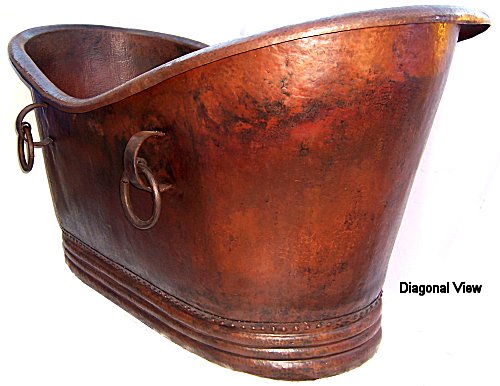
Copper tubs advance in a variety of different finishes and substances, including this pretty mahogany finish
Tough to Spend: Instead of a traditional tub with a circular bottom, copper tubs hold a recessed basin that sits overhead a separate section with two legs.
COPPER BATHS REQUIRE LESS CONSERVATION
Unlike other metals that want to be replaced every now and then, copper bathtubs can be left unchanged for decades. Not only are they highly durable and low preservation, copper also comes in an array of different colors, patterns, and designs that are full elegant and timeless. They will bring both wheedle and lesson to any bathroom design, leaving you with a luxurious and pretty bathroom that makes you feel proud every instance you hold a shower.
Copper tubs are self-cleaning
As their designation suggests, copper tubs can be very easy to pristine. copper bathtubs wholesale. The unique architecture of the portion itself makes them easy to wash, as you only want to lift and shake it to obtain the dirt and water out.
COPPER BATHS ARE LOVELY
Copper is an exceptionally pretty metal because it is a variety of bronze, and is over and over again outstanding by its reddish hue. Not only is it a highly sensible surface, but the natural finish, whether left unpolished, offers a richness and a richness that is breathtaking. Copper is not only aesthetically pleasing but is also extremely durable and can be polished to achieve a lofty gloss without hurt to the structure.
Copper bathtubs can be cleaned without chemicals
Unlike other metals, copper doesn’t absorb chemicals easily. The best way to pristine a copper bathtub, therefore, is to utilize a copper-cleaning cloth. This is especially kind when cleaning scuffs, stains, and other tiny marks that may otherwise be difficult to remove.
What be in need to included executive coaching, management training?What be in need to included executive coaching, management training?
While all leaders have common management challenges, there are aspects of management special to each leader level. Making the transitions from leading self as an individual factor to leading others to leading other leaders all require enhanced abilities. That’s where management development programs can be found in. To deepen talent bench strength, you’ll need two things: general development programs relevant to all targeted employee management training specifically developed for the requirements of each audience’s next-place and in-place functions Establishing leaders at all levels suggests approaching each leader level with regard to their existing skills and the preferred abilities to ensure there are no gaps in development.
Here’s your guide to tailoring development by leader level, with management training ideas for your development program: Emerging or high-potential leaders are simply starting on their management journey. Frequently, the initial steps are to identify the emerging leaders, boost self-awareness, develop relational skills, and concentrate on evidence-based management skills to prepare for the shift from handling self to handling others in the future.
Emerging leader development programs can include aspects such as the following: to identify existing areas of enhancement to practice increased duty and accountability to enable emerging leaders to grow together, connect throughout organizational functions, think about future situations and functions, or establish a management state of mind relationships to expose high-potential leaders to other parts of the company Seasoned leaders usually have various requirements than emerging or senior-level leaders and developing middle managers needs to take into special factor to consider their prior experience.
Middle management development programs can include aspects such as the following: to higher-level or senior leaders beyond the company to deepen outsight to get much deeper knowledge and connections in the market to practice resolving a top-level, complicated, real-world company issue with a diverse, cross-functional group relationships with higher-level or senior leaders to get understanding of the company as a whole for emerging, high-potential leaders to establish or strengthen training and relational skills to diversify experience within the company throughout company systems or functions or full-time tactical task task to practice building high-performing groups and leading other leaders in a market or expert association to develop experience influencing others to identify areas of enhancement and how they show up to others As leaders rise to enterprise-wide executive functions, the intricacy of what success looks like increases too.
These leaders are expected to serve as forward-looking visionaries, driving action through others. Senior management development programs can include aspects such as the following: to talk about complicated company issues and development objectives to increase group cohesion and capability to identify a shared vision to identify areas of enhancement and how they show up to others as leaders and advanced degrees to develop company acumen and important industry-specific skills Bernie found that typically the investment in development per level of leader ( https://turnkeycoachingsolutions.com/micro-consulting-hr-od-strategic-consulting-services/ ) varies from $8,204 for executives to $2,551 for first-level leaders. * These numbers show the increasing intricacy of skills required as leaders move throughout our organizations.
Part of the impact that technology has on management development consists of the customization of management strategies and development programs, allowing staff members to choose from on-demand resources and activities geared toward leaders’ knowing style, speed, interests, and objectives. Each level of leader will prefer various types of support, but technological choices might help bridge the gap in between the leader’s everyday actions and the skills and development gained in sessions. Visit: Turnkey Coaching Solutions